
RT 1: Nuclear Properties
Fundamental nuclear properties are key to many applications of nuclear science, including nuclear theory, nuclear astrophysics, and nuclear energy and are not yet fully understood, especially for exotic nuclei far from stability. Within the RT1, different types of experiments will be performed at the Oslo Cyclotron Laboratory (OCL) and at larger accelerator facilities abroad such as RIKEN (Japan), ISOLDE (CERN), FRIB (the USA).
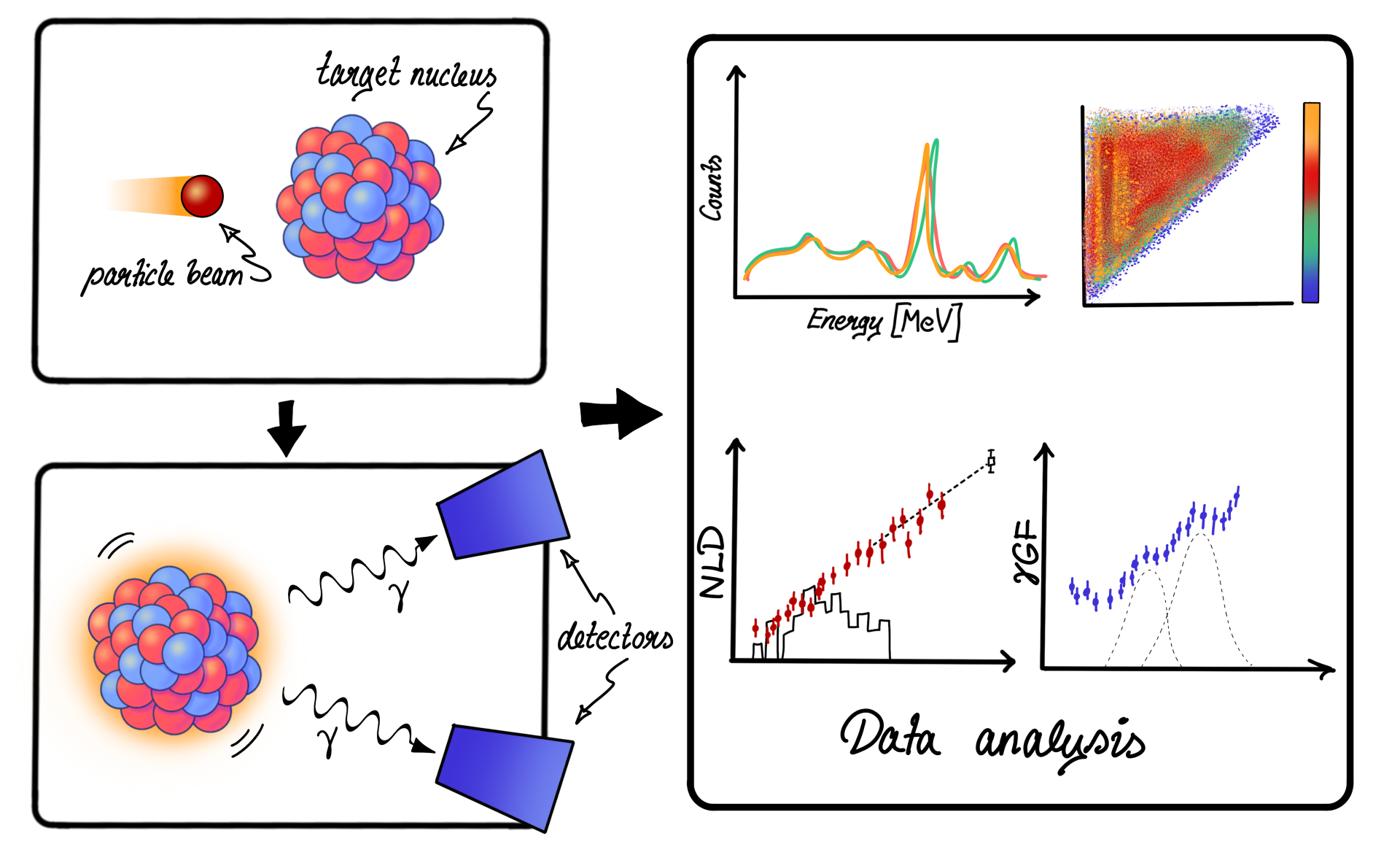
One class of experiments will focus on providing data to constrain cross sections for neutron-capture reactions. Neutron capture is the reaction mechanism that is responsible for producing minor actinides in nuclear reactors, and for producing all elements heavier than iron in stars and explosive stellar environments. Reliable neutron-capture reaction rates will be extracted for short-lived unstable nuclei by measuring the properties of the compound system using charged-particle induced reactions.
Two of the main ingredients to calculate radiative neutron-capture cross sections are the nuclear level density (NLD, number of quantum levels per excitation-energy bin) and the g-ray strength function (𝛾SF, average decay probability) and will be measured using the Oslo method. The experimentally deduced neutron-capture rates will provide improved input to large-scale nuclear reaction network calculations to model nucleosynthesis in reactors or stellar environments, connecting RT1 with RT3.
Because it is impossible to constrain all reaction cross sections experimentally, such network calculations must rely partially on theoretical predictions of nuclear properties, especially for exotic nuclei far from stability. It is therefore important to test theoretical model predictions and determine their reliability. This can be done by measuring fundamental properties of exotic nuclei such as masses, ground- state spins and parities, the spectrum of low-lying excited states, transition probabilities between them, and electromagnetic moments for both ground and excited states. We will expand our successful experimental program towards exotic nuclei that have not been studied in sufficient detail in the past.
New accelerator facilities for radioactive ion beams and new instrument developments will enable us to push the frontier of nuclei that can be studied experimentally. The neutron-rich nuclei of interest are primarily produced in fission reactions. Studying the properties of these fission fragments provides furthermore valuable information on the fission process itself, the decay heat produced in reactors, and the probability for 𝛽-delayed neutron emission. These aspects connect to RT2.
People involved
Key Researchers:
- PI Eda Sahin (UiO)
- Andreas Görgen (UiO)
- Ann-Cecilie Larsen (UiO)
- Sunniva Siem (UiO)
- Vetle Wegner Ingeberg (UiO)
- Kevin Ching Wei Li (UiO)
- Maria Markova (UiO)
- Azusa Inoue (UiO)
PhD students:
- Johannes Sørby Heines (UiO)
- Lauren Tracy Bell (UiO)
- Wanja Paulsen (UiO)
- Erlend Lima (UiO)
- Andreas Halkjelsvik Mjøs (UiO)
- Jon Kristian Dahl (UiO)
- Trine Kvam Olafsen (UiO)
- Henrik Døvle Andrews (UiO)
- Gulla Louise Serville Torvund (UiO)
- Hyeji Lee (UiO)
M.Sc. students
- Lise Granheim (UiO)
- Therese Einskau Mørk
External collaborators:
- Takaharu Otsuka, Professor, University of Tokyo, Japan
- Noritaka Shimizu, Professor, University of Tokyo, Japan
- Stephane Goriely, Senior Researcher, Université libre de Bruxelles, Belgium
- Mathis Wiedeking, Senior Researcher, Lawrence Berkeley National Laboratory , California, USA