RT 4: Radionuclide production and Speciation
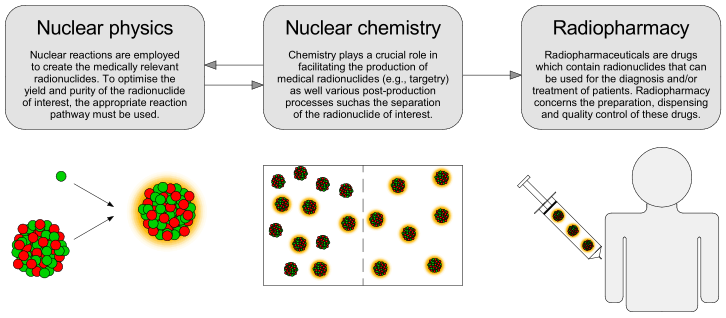
In this highly multidisciplinary research theme, several scientific disciplines are engaged to identify and study emerging radionuclides which may be critical for medical and industrial applications. Radionuclides (which consist of nuclei that spontaneously decay) are pivotal in many cutting-edge methods to diagnose and treat cancer. As such, one of the main goals of this research theme is to facilitate the upscaling and industrial-scale production of these emerging radionuclides. Radionuclide therapy enables a highly personalised form of cancer therapy which can be tailored to minimise the damage to healthy tissue. In RT4, there is a particular interest towards radionuclides (or combinations thereof) which are suitable for theranostics, which enables the simultaneous diagnosis and treatment of cancer. There is also a focus on alpha-emitting radionuclides which are amenable for Targeted Alpha Therapy (TAT). This research theme consists of three work-packages:
(WP4-1) EMERGING RADIONUCLIDES - Optimising the production of high-specific activity quantities of emerging radionuclides.
The aim of this work package is to increase the availability of emerging radionuclides by studying novel reactions for their production. The associated experiments will be conducted at the Oslo Cyclotron Laboratory (OCL) as well as other facilities, both locally and abroad.
(WP4-2) NUCLEAR CHEMISTRY AND RADIOPHARMACY: Improving availability of radionuclides for medical and industrial manufacturing
One of the primary objectives of this work package is to develop target materials which are robust towards high currents, enabling improvements in production. The composition of new successful target materials will be addressed for the compatibility of purification methods developed according to the requirement of automated processing and radiosynthesis. There is a particular focus on synergistic studies which focus on the chemical separation of the radionuclides studied in the other work packages of RT4.
(WP4-3) Qualification of the neutron activation target station at HUNT
The HUNT infrastructure is a national neutron irradiation facility jointly operated by IFE and UIO. The facility is in the process of being established and will consist of two small compact neutron generators. This infrastructure will enable neutron-induced reactions to be studied, covering a wide range of interests, such as medical isotopes and space applications.
People involved
Key researchers
- PI Liv Stavsetra (IFE/UiO)
- Andrew Voyles
- Bent Wilhelm Schoultz (NMS, UiO)
- Deniz Avsar (IFE/UiO)
- Georgios Kalantzopoulos (IFE)
- Håvard Gausemel (Bayer/UiO)
- Jon Petter Omtvedt (UiO)
- Kevin C. W. Li (UiO)
- Vetle W. Ingeberg (UiO)
- Trond V. Hansen (UiO)
- Sindre Hassfjell (Thor Medical/ UiO)
- Sunniva Siem (UiO)
- Syed Mohammed Nuruddin (UiO)
PhD students
- Elise Malmer Martinsen (UiO)
- Hannah Ekeberg (UiO, IFE)
- Ida Plahter Rosenqvist (UiO)
- Marianna Canonaco (UiO, Radiumhospitalet)
MSc students