
Research Theme 2: Nuclear Fission
The nuclear fission process is known for being an important source of energy; however, it is also a fascinating arena for studying the nuclear forces. Fission is so complicated that the process is still not completely understood. In Research Theme 2, we therefore work on explaining new aspects of the fission process - more than 80 years after its discovery.
 Figure 1: Illustration of the nuclear fission process. Credit: L. Petizon.
People involved
Key researchers:
- PI Dr. Ali Al-Adili (Uppsala U)
- Professor Sunniva Siem (UiO)
- Dr. Dorthea Gjestvang (UiO)
- Dr. Jonathan N. Wilson (IJC-Lab.)
- Dr. Jørgen Randrup (LBNL)
- Professor Ramona Vogt (LLNL & UC Davis)
- Dr. Darren Bleuel (LLNL)
- Dr. Mátyás Hunyadi (Institute for Nuclear Research, Hungary)
- Dr. Lóránt Csige (Institute for Nuclear Research, Hungary)
- Dr. Sunniva Rose (UiO & Norsk Kjernekraft AS)
- Dr. Stephan Oberstedt (JRC, European Commission)
PhD students:
- Gulla Louise Serville Torvund (UiO)
- Henrik Haug (UiO)
- Maia Oline Grund Wirgenes (UiO)
- Marius Torsvoll (UiO)
What is Nuclear fission?
When a heavy atomic nucleus undergoes fission, the fundamental forces of nature begin to compete. The strong nuclear force works to hold the nucleus together, while the electromagnetic force pushes its positively charged protons apart. Triggered by a small perturbation, the nucleus starts to deform like a drop of liquid until it finally snaps, splitting into two, and sometimes three, smaller nuclei. Together, these lighter nuclei weigh slightly less than the original nucleus because the daughter nuclei are more tightly bound. This missing mass is converted into energy, which is harnessed, for example, in nuclear reactors.
Immediately after the split, the newly formed fragments obtain a large amount of internal energy as well as linear- and angular momentum. Put simply, they are very hot, moving fast, and spinning rapidly. To release this energy and reach a more stable state, they emit neutrons and high energy gamma radiation, as illustrated in Figure 2.
The emitted neutrons play a crucial role in sustaining a chain reaction in a nuclear reactor by triggering new fission events. The gamma rays, meanwhile, contribute to the heat that is ultimately used to produce electricity. Despite more than 80 years of fission research, many details of this process are still not fully understood. What determines how excited the fragments are and how fast they spin? How do the properties of the emitted particles change when different nuclei undergo fission? And how can improved fission models contribute to safer and more efficient future nuclear power plants? These open questions motivate Research Theme 2, which focuses on fundamental studies aimed at deepening our understanding of how the fission process really works.
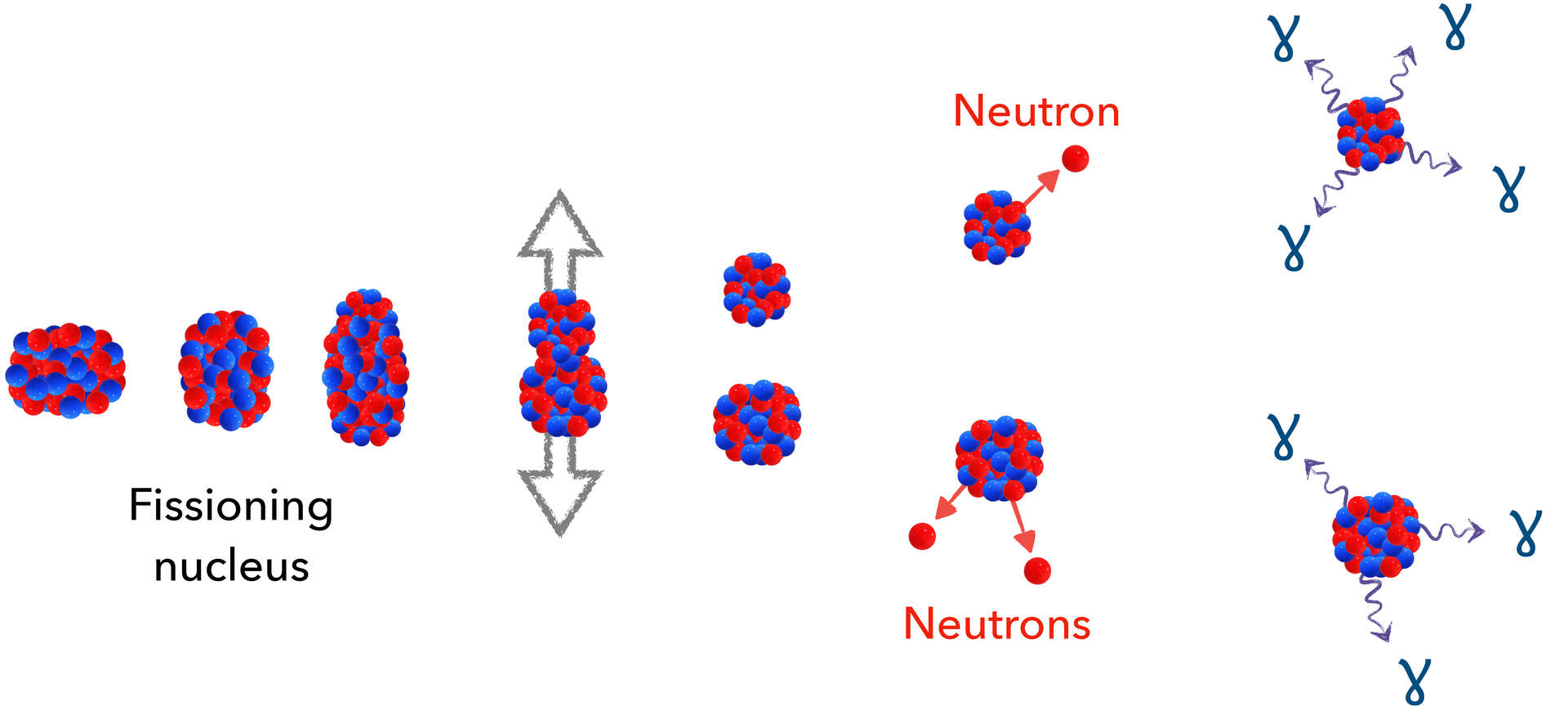
Figure 2: How the nuclear fission process unfolds. The fragments have excitation energy and angular momentum; meaning they are hot and they spin. They will therefore send out neutrons and gamma rays. Credit: Dorthea Gjestvang
What we will investigate
In Research Theme 2 we focus on two key areas that are central to nuclear fission. The first concerns fission yields, which describe the probabilities of producing specific nuclei when a heavy nucleus splits. By studying these hundreds of possible yields, we contribute to a deeper understanding of the quantum mechanical fluctuations that ultimately decide how fission unfolds. This work also provides insight into how rare and exotic nuclei are created through the fission process and in astro-physical processes in neutron-star mergers and the rapid-neutron capture.
The second focus area is the measurement of gamma rays emitted by the fission fragments. Together with neutrons, these gamma rays carry signature information on how excitation energy and angular momentum are shared between the daughter nuclei. By measuring them, we gain valuable information about the initial state of the fragments immediately after fission.
Our approach is twofold. We measure average gamma ray properties, such as their energy and how many are emitted per fission event, as well as discrete gamma rays from specific fragment nuclei. These measurements provide important benchmarks for fission simulation codes and help assess whether the underlying physics is correctly implemented. To support this effort, we develop and test state of the art models of nuclear de-excitation, improving predictions in regions where experimental data are scarce.
Because our work focuses on the properties of the fission fragments, Research Theme 2 is closely connected to Research Theme 1 on nuclear properties. In addition, since the energy released in fission is exploited in nuclear reactors and gamma ray heating is an important aspect of reactor physics, our results are also directly relevant to Research Theme 3 on nuclear simulations.